COMPARE

Exploring the Best SCA Tools

Evaluate the best software composition analysis (SCA) tools on the market, and see how Sonatype Lifecycle stacks up against the others.


Not All Software Composition Analysis Tools Are Created Equal

Modern apps are built using open source, but this speed comes with risk. Without full visibility into the components you’re using, code can be shipped with known vulnerabilities, license risks, or outdated dependencies. While many SCA solutions claim they can handle these risks — development teams are often left with noise that slows down developer productivity. 

See How Sonatype Lifecycle Compares to Other Solutions

Features

Sonatype

Snyk

Black Duck

JFrog

Mend

Flexible Policy Engine
Create custom policy on over 30 constraints
PARTIAL | Limited policy options with minimal security and legal controls
PARTIAL | Lacks support for AI/ML, EoL, and popularity
PARTIAL | Lacks flexibility with limited parameters
PARTIAL | Lacks global, default, and reference policies and granular conditions
Automated Remediation
No breaking changes and solves all direct and transitive risk
PARTIAL | Poor data quality that offers no build stability or application quality
PARTIAL | Only applies when CVE is a different version than what is impacted
PARTIAL | Lacks natively provided developer centric remediation
PARTIAL | Lacks reliability, vulnerability, and malware data
Contextual Prioritization and Remediation Guidance
Actionable advice focused on clearing your backlog
PARTIAL | Confusing and creates extra rework
PARTIAL | Lacks breaking changes, upgrade availability, and only Java reachability is supported
PARTIAL | Lacks comprehensive messaging through developer tools
PARTIAL | Ineffective risk prioritization limited to violation criticality with no awareness to breaking changes
SBOM Management
End-to-end SBOM management that includes ingestion, generation, continuous monitoring, auditing, cataloging, searching, VEX, and distribution capabilities
PARTIAL | Lacks data quality, storage, auditing, standardization, sharing, and self-hosted support
PARTIAL | Lacks data quality, storage, auditing, standardization, and sharing
PARTIAL | Lacks standardization, legal compliance context, VEX, multi-BOM types, reactive monitoring
PARTIAL | Lacks ingestion, full compliance, and post-production application monitoring
AI Model Management
AI Software Composition Analysis (SCA) gives you visibility and control over AI/ML usage
PARTIAL | Lacks risk governance, AI-specific policy, and AIBOMs
PARTIAL | Lacks ingestion, policy-driven governance, and compliance with AI regulations

Sonatype

Features
Flexible Policy Engine
Create custom policy on over 30 constraints
Automated Remediation
No breaking changes and solves all direct and transitive risk
Contextual Prioritization and Remediation Guidance
Actionable advice focused on clearing your backlog
SBOM Management
End-to-end SBOM management that includes ingestion, generation, continuous monitoring, auditing, cataloging, searching, VEX, and distribution capabilities
AI Model Management
AI Software Composition Analysis (SCA) gives you visibility and control over AI/ML usage

Snyk

Features
Flexible Policy Engine
PARTIAL | Limited policy options with minimal security and legal controls
Automated Remediation
PARTIAL | Poor data quality that offers no build stability or application quality
Contextual Prioritization and Remediation Guidance
PARTIAL | Confusing and creates extra rework
SBOM Management
PARTIAL | Lacks data quality, storage, auditing, standardization, sharing, and self-hosted support
AI Model Management

Black Duck

Features
Flexible Policy Engine
PARTIAL | Lacks support for AI/ML, EoL, and popularity
Automated Remediation
PARTIAL | Only applies when CVE is a different version than what is impacted
Contextual Prioritization and Remediation Guidance
PARTIAL | Lacks breaking changes, upgrade availability, and only Java reachability is supported
SBOM Management
PARTIAL | Lacks data quality, storage, auditing, standardization, and sharing
AI Model Management

JFrog

Features
Flexible Policy Engine
PARTIAL | Lacks flexibility with limited parameters
Automated Remediation
PARTIAL | Lacks natively provided developer centric remediation
Contextual Prioritization and Remediation Guidance
PARTIAL | Lacks comprehensive messaging through developer tools
SBOM Management
PARTIAL | Lacks standardization, legal compliance context, VEX, multi-BOM types, reactive monitoring
AI Model Management
PARTIAL | Lacks risk governance, AI-specific policy, and AIBOMs

Mend

Features
Flexible Policy Engine
PARTIAL | Lacks global, default, and reference policies and granular conditions
Automated Remediation
PARTIAL | Lacks reliability, vulnerability, and malware data
Contextual Prioritization and Remediation Guidance
PARTIAL | Ineffective risk prioritization limited to violation criticality with no awareness to breaking changes
SBOM Management
PARTIAL | Lacks ingestion, full compliance, and post-production application monitoring
AI Model Management
PARTIAL | Lacks ingestion, policy-driven governance, and compliance with AI regulations
bg-gradient-pattern_left
bg-gradient-pattern_right

Software Composition Analysis with Sonatype Delivers Results

00
%
Faster Mean Time to Remediate (MTTR)
00
%
Risk Reduction to total vulnerable components
00
%
of all components upgraded to a higher quality version

How to Choose Between SCA Solutions

Discover key criteria to evaluate and select the best SCA solution for your organization. While many tools appear to have similar features, the depth of capabilities can vary significantly.

Data Accuracy

Prioritize SCA software that offers rich data intelligence to deliver accurate results to you quickly. 

Developer Productivity

Evaluate how easily developers can act on security feedback. SCA software should have actionable guidance that doesn’t slow down workflows. 

Automation

Ensure the solution automates policy enforcement, waivers, and security fixes to accelerate reviews and unlock productivity gains. 

Proven Artifact Repository

Work where and how you want with world-class security that runs with any binary artifact repository or without one.

Forrester_white_cropped

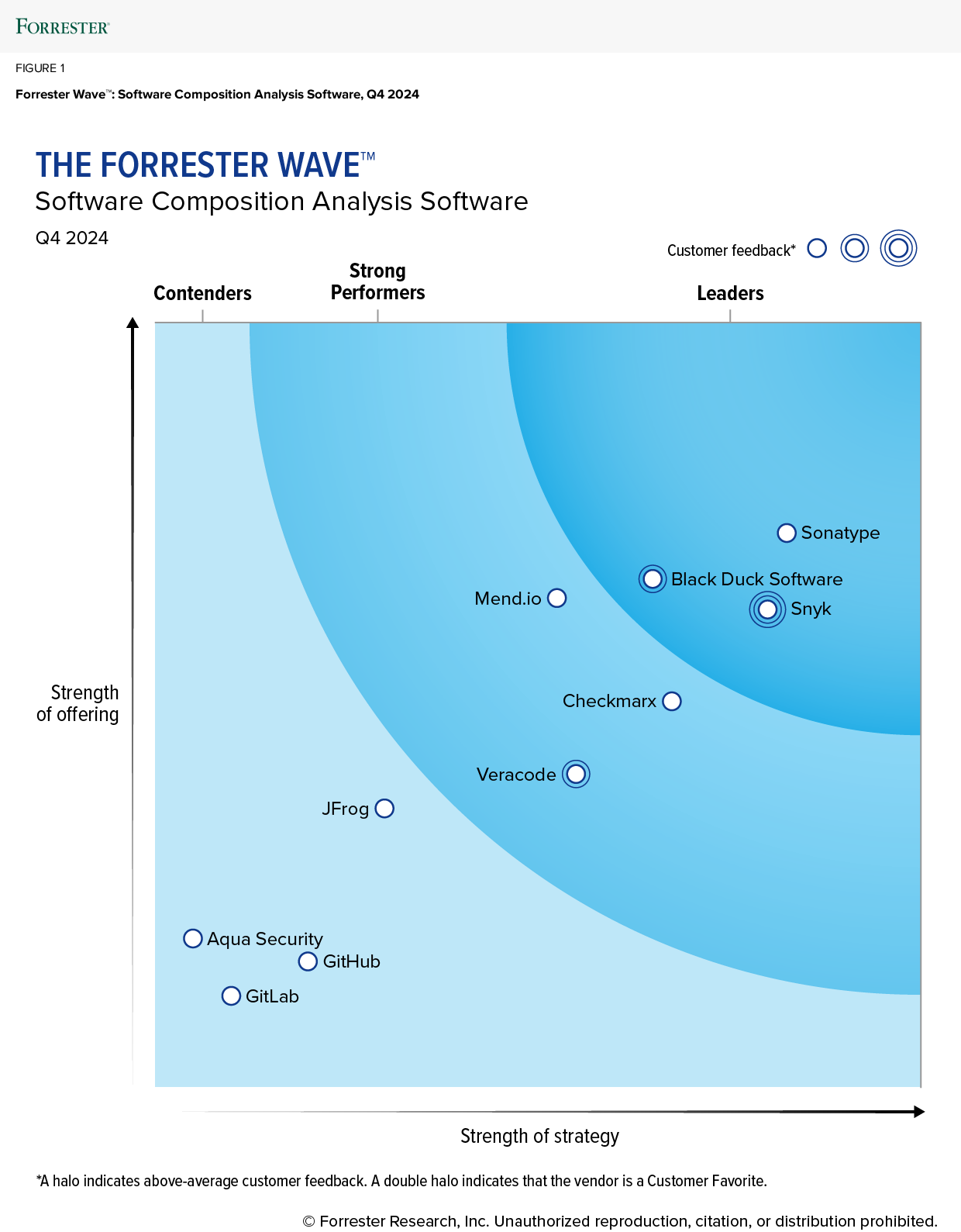
Sonatype Named a Leader in Forrester Wave for SCA Software

Forrester evaluated 10 top SCA providers and named Sonatype a leader with the highest possible scores in the Forrester WaveTM: SCA Software 2024
What Are the Best Software Composition Analysis (SCA) Tools? 

The best SCA tools combine accurate vulnerability detection, strong policy enforcement, and automation to reduce security backlogs and risk without slowing development. Sonatype Lifecycle stands out as a top choice for enterprises, earning a Leader position in The Forrester Wave™ for Software Composition Analysis. Praised for its revolutionary vision, Sonatype received the highest scores in malicious package detection, SBOM management, policy enforcement, and AI-powered component analysis.

The Challenge with Free SCA Solutions

Free SCA software may seem appealing at first, but they come at a price. These tools typically lack automation, remediation, guidance, policy enforcement, and SBOM support — and more importantly, deliver inaccurate results based on poor datasets. The result? Developers spend more time compensating for the tool’s shortcomings than actually securing their software. Sonatype Lifecycle offers precise AI-powered analysis, full SDLC integration, and the automation teams need to secure their software at scale while maintaining development velocity.

Beyond the Solutions: Comparing Leading SCA Providers

SONATYPE VS. SNYK

Don’t Let AI Risks Slip Through the Cracks

Snyk offers no coverage for AI and ML model scanning or software composition analysis, creating a critical gap as these technologies become core to modern development. Sonatype delivers full-spectrum analysis with AI model and library management and earned the highest score in AI component analysis in The Forrester Wave™ for SCA.

SONATYPE VS. BLACK DUCK

Stop Slowing Developers Down with Manual Remediation

Black Duck lacks developer-friendly automation, forcing teams to waste time on manual fixes and breaking the flow of innovation. Sonatype puts developers first with intuitive, automated remediation and seamless integrations across the SDLC. From pull requests to production, Sonatype keeps your teams moving fast and secure.

SONATYPE VS. JFROG

Eliminate False Positive Noise

JFrog has a large false positive and negative rate, causing review cycles to drag and critical issues to be ignored. Sonatype delivers unparalleled precision with near zero false positive and false negative rates, helping developers be more productive and focus on what actually needs to be fixed.

SONATYPE VS. MEND

Policy Gaps Put Your Software at Risk

Mend falls short on governance, offering no custom reference policies and no ability to set global policies across your organization. Sonatype delivers enterprise-grade policy control with pre-built reference policies, customizable policies, and a clean, intuitive interface. It’s the control your security team demands, with the efficiency your developers deserve.

Where Do Most SCA Solutions Go Wrong? 

Most SCA software solutions miss the mark where it counts. They create noise by flooding developers with false positives, and miss true threats, false negatives. The absence of accurate data can ultimately create risk.

SONATYPE GETS IT RIGHT.

Fueled by the industry’s most accurate and curated data, Sonatype eliminates the noise. It filters out irrelevant alerts, uncovers real vulnerabilities — including malicious and AI/ML components — and delivers precise, actionable insight. No false positives. No wasted time. 


Flexible Policy Engine

Automatically enforce policy and continuously monitor  to reduce risk. 

Contextual Prioritization

Get accurate findings with reachability and upgrade availability data.

Waivers & Exemptions

Automatically waive low-risk violations to drive developer productivity.

Automated Remediation

Streamline dependency management with automated waivers and PRs.

Frequently Asked Questions

What is SCA software composition analysis?

Software Composition Analysis (SCA) identifies open source components in your codebase and scans them for vulnerabilities, licenses, and quality issues. Sonatype Lifecycle has redefined Software Composition Analysis (SCA) with the industry's first AI SCA tool that combines automated dependency management and SBOM management, helping teams innovate faster using AI and open source while managing open source software security risks effectively.

What are the best software composition analysis (SCA) tools? 

The best SCA tools combine accurate vulnerability detection, strong policy enforcement, and automation to reduce security backlogs and risk without slowing development. Sonatype Lifecycle stands out as a top choice for enterprises, earning a Leader position in The Forrester Wave™ for Software Composition Analysis. Praised for its revolutionary vision, Sonatype received the highest scores in malicious package detection, SBOM management, policy enforcement, and AI-powered component analysis. Sonatype Lifecycle is widely regarded as the most advanced and enterprise-ready SCA solution on the market today.

What is the difference between SCA Tools and SAST Tools?

SAST and SCA serve different but complementary roles in application security. Static Application Security Testing (SAST) analyzes your custom source code to find bugs and vulnerabilities, while Software Composition Analysis (SCA) focuses on your open source dependencies, identifying vulnerabilities, license risks, and even malicious packages. While SAST is great for catching coding flaws and vulnerabilities, SCA is essential for managing the hidden risks in third-party components that make up the majority of modern applications. Sonatype Lifecycle excels as an SCA solution by providing AI-driven threat detection, automated policy enforcement, and deep integration across the SDLC, giving teams the visibility and control they need to secure their software supply chain without slowing development.

Which software composition analysis solutions provide the most accurate and complete inventory of direct and transitive dependencies?

While there are many SCA providers like Snyk, Black Duck, JFrog, and Mend, Sonatype stands out among them by providing the most accurate and complete inventory of both direct and transitive dependencies. Unlike tools that rely solely on static manifest files (e.g., package.json, pom.xml, etc.), Sonatype performs deep binary fingerprinting to identify components, regardless of how they are referenced or bundled.

What sets Sonatype apart:

  • Binary-Level Precision: Sonatype doesn’t just parse files, it analyzes the actual artifacts being built and deployed. This ensures it captures dependencies introduced through shadowed JARs, nested packages, or third-party libraries that never appear in the manifest.
  • Transitive Dependency Visibility: Sonatype goes several layers deep, uncovering all transitive components pulled in by tools like Maven, npm, Gradle, and pip. It also correctly de-duplicates and de-obfuscates packages to avoid false positives.

Proprietary Intelligence Data: Sonatype maintains an unmatched knowledge base of over 150 million components, which enables Sonatype Lifecycle to associate each component with precise metadata including licensing, vulnerabilities, maintainers, and more to ensure that your inventory is not just complete, but actionable.

Does vulnerability data matter in an SCA security tool?

Yes, vulnerability data accuracy is paramount. Most public feeds are incomplete or delayed. Sonatype’s proprietary intelligence uses machine learning, secondary expansion, curated research, and live source monitoring to maintain high precision and minimize noise. This ensures Sonatype Lifecycle delivers timely, high-confidence vulnerability alerts and remediation guidance.

What's the best dependency scanner? 

The best dependency scanning and management platform isn’t just the one that finds vulnerabilities — it’s the one that gives you complete, accurate insight, actionable intelligence, and automation that empowers developers rather than slows them down. Sonatype Lifecycle offers best-in-class dependency management. While many dependency scanning tools rely only on manifest files (like package.json or pom.xml), Sonatype Lifecycle users binary-level fingerprinting to identify all components in your build — including shadowed JARs, nested packages, and transitive dependencies. This ensures a complete and accurate inventory of both direct and transitive dependencies, reducing blind spots that can be exploited by attackers.

Which software composition analysis solutions go beyond CVEs to identify malicious or obfuscated components?

While the CVE program provides a common naming system for publicly disclosed vulnerabilities, Sonatype has built its own proprietary vulnerability research program to account for significant limitations in that system including slow issuance, incomplete coverage, and inconsistent component mapping. Unlike other providers that have a heavy reliance on CVEs, Sonatype’s vulnerability intelligence is not dependent on CVEs. This means Sonatype customers are better protected and have greater insight into the breadth of risk within the toolchain. 

Are there any free SCA tools solutions that are highly recommended?

While there are free SCA tools on the market, they do not fully mitigate your risk or provide any automation. Free SCA tools such as OWASP Dependency‑Check and GitHub Dependabot provide basic vulnerability alerts, but they often suffer from high false‑positive rates, limited transitive dependency analysis, reliance on delayed public data, and no automated policy enforcement or remediation guidance. A comprehensive paid solution like Sonatype Lifecycle delivers enterprise-grade capabilities including AI‑powered malicious package detection, automated governance across the SDLC, real‑time proprietary vulnerability intelligence, and advanced remediation suggestions. For organizations building software at scale or operating in regulated environments, Lifecycle offers the visibility, control, and speed needed to manage real open‑source supply chain risk that free tools simply can’t match.

What are the considerations for choosing an SCA solution?

When evaluating the best SCA tools on the market, key criteria your organization should consider include accurate, real-time vulnerability intelligence, seamless integration across the SDLC, automated policy enforcement, SBOM management, developer-friendly automated remediation, and AI-powered malicious behavior detection. Sonatype Lifecycle excels across all these areas, offering deep automation, comprehensive coverage, and industry-leading intelligence to help teams secure their software supply chain with confidence.

Which SCA tools integrate best with existing environments (GitHub Actions, GitLab, Jenkins, Azure DevOps, etc)?

Sonatype offers deep and mature integrations with a wide range of CI/CD and DevOps platforms, including GitHub Actions, GitLab, Jenkins, Azure DevOps, Bitbucket, and more. These integrations allow teams to automate policy enforcement, generate SBOMs, and block bad components in pipelines without disrupting workflows. Sonatype also supports infrastructure-as-code integrations, IDE extensions, and REST APIs, making it highly adaptable to existing environments. This level of ecosystem integration is consistently ranked among the strongest in the industry.

What SCA tools provide the best SBOM generation and VEX support?

Sonatype provides robust SBOM (Software Bill of Materials) generation capabilities in CycloneDX and SPDX formats, with rich metadata including component hashes, licenses, and policy violations. With full VEX (Vulnerability Exploitability eXchange) support, users are able to better prioritize vulnerabilities based on exploitability and runtime context. While other providers offer SBOM features, Sonatype is a recognized leader in the The Forrester Wave™: SCA Software 2024, scoring the highest possible scores for generation, export, sharing, ingestion, and analysis of SBOMs.

Is Sonatype Lifecycle the right SCA solution for my organization?

If your organization values fast, secure, and scalable software delivery, Sonatype Lifecycle is an ideal solution. Recognized by Forrester as the top SCA leader, Lifecycle provides proactive detection of vulnerabilities and malicious components, AI component analysis, automates open source governance, and integrates effortlessly into existing developer workflows. With a strong focus on precision, automation, and ease of adoption, Lifecycle empowers teams to secure their software supply chain without slowing down innovation.

See Lifecycle in Action

glyph branded arrow
Book a Demo