
SONATYPE SOLUTIONS
Open Source Malware Protection That Stops Threats Instantly
Identify and block open source malware with the Sonatype platform to secure every stage of your software pipeline starting at the perimeter.

Block Malware. Build Fast. Breathe Easy.
Enterprises increasingly rely on open source components and AI models, making them prime targets for malicious code — but traditional perimeter and end point security is not enough. Sonatype offers open source malware protection that goes beyond what traditional tools catch to prevent malware from entering the software supply chain to reduce your risk of breaches.
Secure Your SDLC with Sonatype’s Open Source Malware Protection Solutions
Block Malware Early
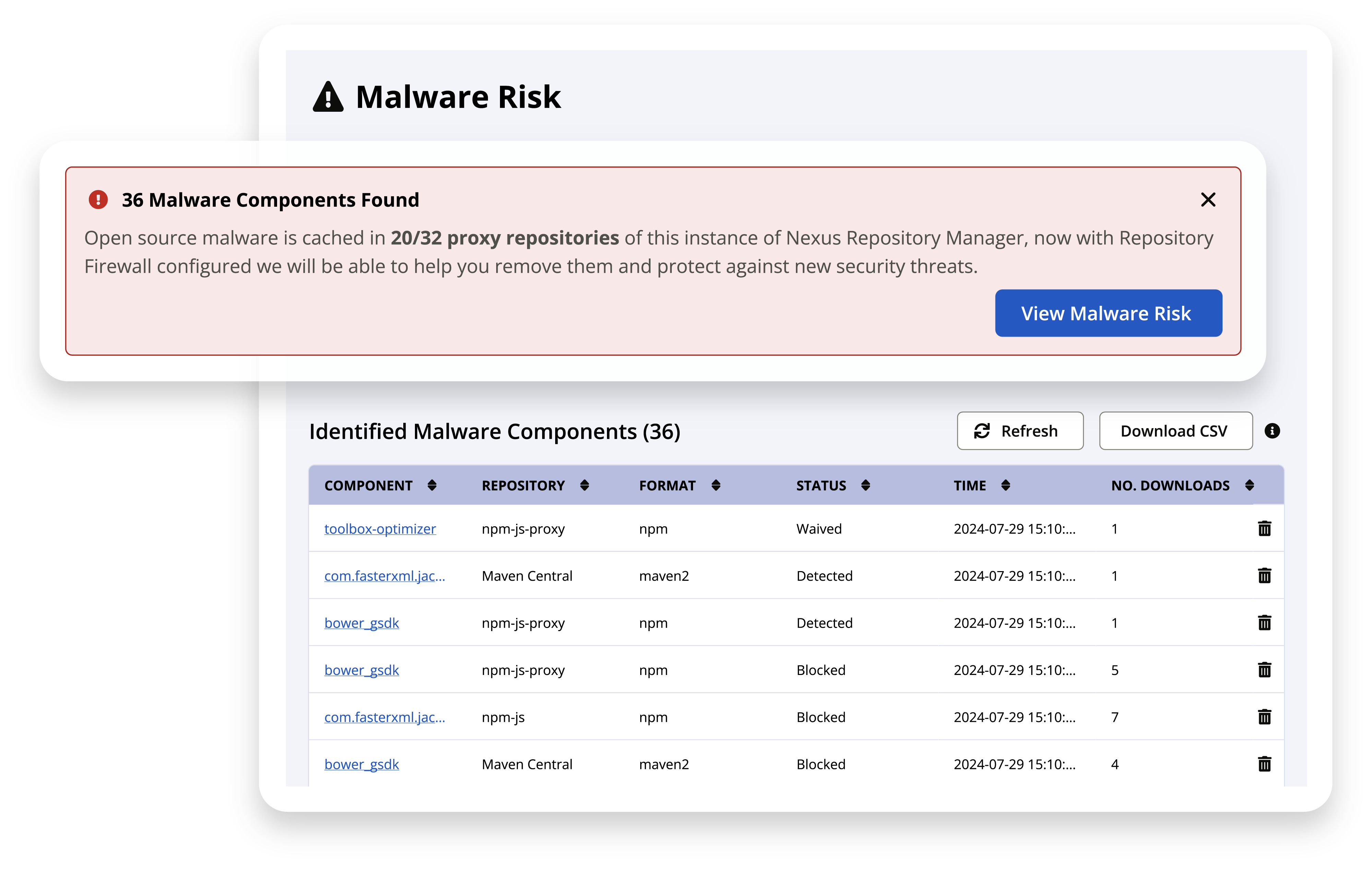
Sonatype Repository Firewall automatically blocks malicious open source components before they enter your development environment, protecting teams from potential vulnerabilities and compliance issues. By analyzing open source components and AI models in real time, it prevents known open source malware and suspicious components from impacting your projects. Establish policies based on risk tolerance. Suspicious components are automatically reviewed and quarantined for policy violations, while known malicious packages and components are instantly blocked from entering your repository.
Continuous Risk Monitoring
Sonatype Lifecycle empowers organizations to safeguard their software supply chain by identifying and remediating open source malware early in the development process. Seamlessly integrated into developer tools and workflows, it continuously monitors component activity and enforces custom security policies to prevent malicious code from progressing through the pipeline. This proactive approach ensures that only safe, trusted components are used, reducing risk and preventing open source malware from escalating into production environments.
Reporting and Compliance
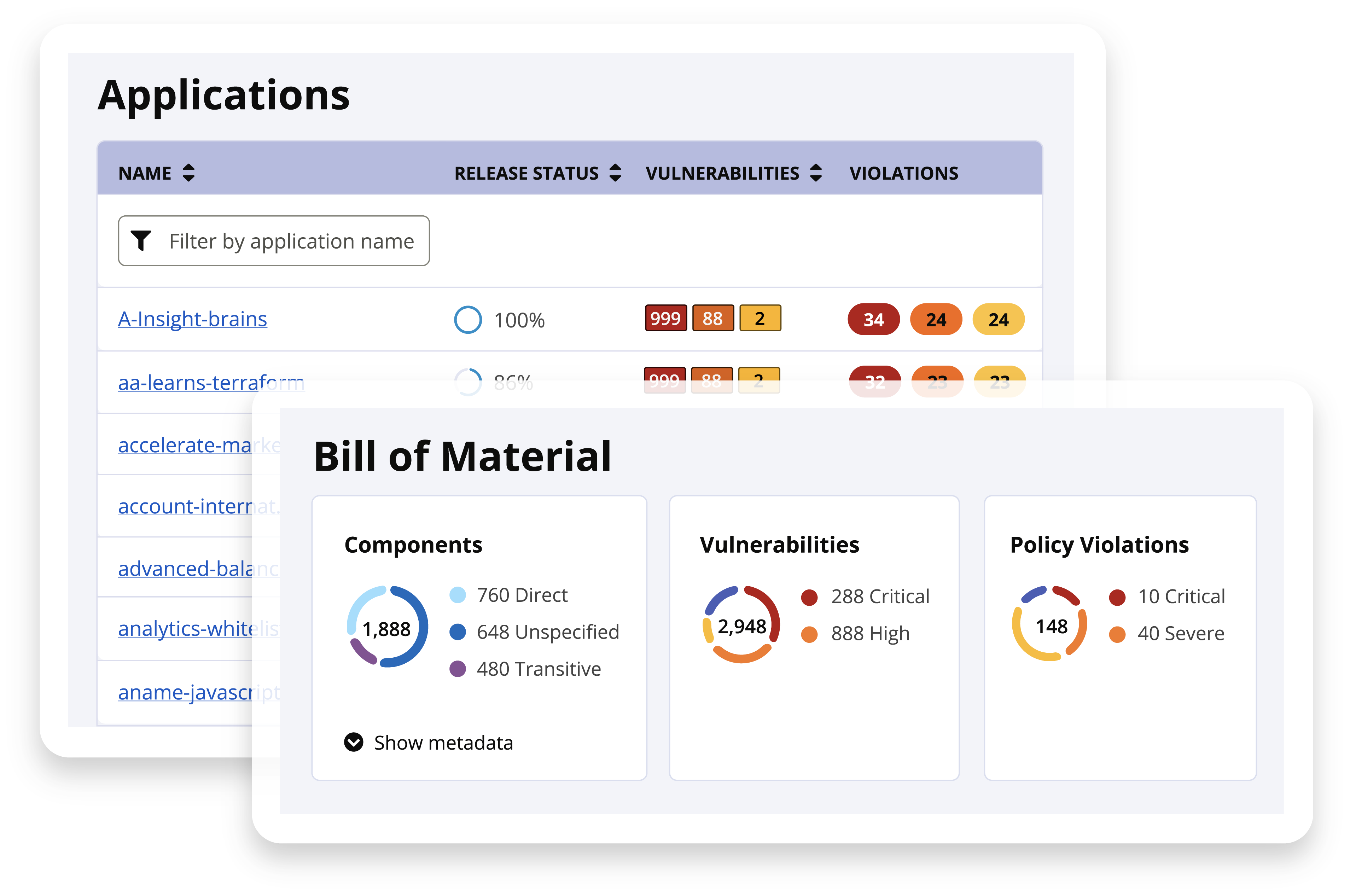
Sonatype SBOM Manager enhances visibility and control by continuously tracking software bills of materials (SBOMs) across all projects. It helps security teams detect and respond to open source malware or vulnerabilities that may have been introduced, even retroactively. By maintaining an up-to-date inventory of all software ingredients, SBOM Manager supports rapid impact analysis and ensures compliance with emerging regulatory and industry standards around software transparency and open source malware protection.
Secure Development
Sonatype SBOM Manager enhances software supply chain security by offering detailed insight into application components, their origins, and dependencies. It enables organizations to track what’s inside their software and AI applications, monitor changes, and identify potential risks. With centralized oversight and seamless integration into development workflows, it empowers teams to make informed decisions, respond swiftly to threats, and maintain continuous assurance across the entire software ecosystem.
Malware Doesn't Stand a Chance
Only Sonatype proactively blocks open source malware before it enters your repository or workflows.
Open Source Malware Protection Best Practices
Protect your software supply chain with open source malware detection that stops threats early, continuously analyzes components across the SDLC.
Enforce Edge-Level Malware Blocking and Quarantine
Block and quarantine malware at the perimeter and before it enters repositories with Repository Firewall.
Continuously Analyze Suspicious Components
Scan dependencies and receive guidance to remediate suspicious components with Sonatype Lifecycle.
Integrate Malware Protection into CI/CD Pipelines
Sonatype Lifecycle integrates with CI/CD tools to enable malware protection early to eliminate rework.
Monitor and Block Malicious AI/ML Model Payloads
Detect, flag, and block malicious AI models with Sonatype’s robust policy enforcement capabilities.
The Fearless Faces That Trust Sonatype
“Thanks to Sonatype we have improved the security of software products, in particular the security of Open libraries within a staging logic.”
Adele Gambarcorta
Head of Software Production Process

“If you are not operating at the pace of an organization that is coming off a breach, then you’re not moving fast enough as it is. We’re not ‘patching’ production anymore. We’re just deploying new environments. This is such a radical change in thinking, database to the cloud, it is a complete mindset change.”
Jamil Farshchi
CISO

“I personally chose Sonatype. Not only does it make my work easier, it simplifies our security process. I definitely recommend it.”
LARS BRÖSSLER
Senior Software Developer
Explore Open Source Malware Insights
Frequently Asked Questions
What is the difference between malware and software vulnerabilities?
Malware refers to malicious code intentionally embedded within open source software components. Unlike vulnerabilities, these threats are deliberately crafted by attackers to infiltrate software supply chains via trusted package repositories like npm and PyPI. Once integrated into development pipelines, they can exfiltrate data, install backdoors, or hijack systems — often evading traditional security tools. The Sonatype platform helps detect both, preventing bad components from entering the development lifecycle or progressing downstream.
How has open source malware evolved in recent years?
Open source malware has grown more targeted and sophisticated, with attackers exploiting trusted ecosystems and developer behavior. In the State of the Software Supply Chain Report, Sonatype reports a 156% year-over-year increase in malicious packages, driven by techniques like typosquatting, dependency confusion, and compromised container images.
Is malicious code protection at the perimeter possible?
Stopping open source malware at the perimeter is challenging because traditional security tools aren’t designed to detect or prevent open source malware. They lack the deep data intelligence needed to detect malicious components in the open source ecosystem. Without visibility into component histories, behaviors, and vulnerabilities, these tools miss critical threats. Sonatype Repository Firewall solves this by integrating with perimeter security tools to deliver advanced intelligence at the edge. Backed by the industry’s most comprehensive open source intelligence, Repository Firewall automatically identifies and blocks malicious packages before they infiltrate your software supply chain.
How does Sonatype integrate with common CI/CD tools and developer workflows?
Sonatype seamlessly integrates with popular CI/CD tools like Jenkins, GitHub Actions, GitLab, and Azure DevOps. Products like Sonatype Lifecycle and Repository Firewall embed policy enforcement and open source malware detection and blocking directly into developer workflows, ensuring security without slowing down builds or releases.
How can AI and machine learning techniques aid in detecting malicious OSS components?
AI and machine learning can identify anomalous behavior, unusual code patterns, and risk signals across vast open source ecosystems. Sonatype applies these techniques to flag suspicious packages in real time, helping teams detect and block open source malware before it enters production environments.
How can companies proactively reduce risk from malware?
Companies can reduce risk by enforcing perimeter protection with Sonatype Repository Firewall, continuously monitoring components with Sonatype Lifecycle, and maintaining accurate and complete SBOMs. Proactive governance, real-time threat intelligence, and developer education are key to defending against modern open source malware threats.
How does open source malware infiltrate the SDLC?
Malware often enters the software development lifecycle through compromised open source packages, malicious dependencies, or unauthorized code changes. Attackers target developers by hiding open source malware in seemingly trusted components and packages, evading traditional defenses. Examples of this include:
-
Malicious Code in Third-Party Dependencies: Attackers inject malicious code into open source packages that developers unknowingly use, introducing malware into builds.
-
Shadow Downloads: Dependencies downloaded from unapproved sources that bypass security controls can introduce malicious code into pipelines.
-
Compromised Container and VM Images: Attackers distribute containers or VM images preloaded with hidden malware, infecting builds if containers are not verified.
-
Malicious AI/ML Model Payloads: Threat actors embed malware in pretrained AI or ML models that execute malicious code when imported, compromising builds.
-
Typosquatting and Namespace Hijacking Attacks: Malicious packages mimic trusted ones using slight name changes to get users to download unknowingly.
Infected CI/CD Pipeline Plugins and Scripts: Attackers compromise CI/CD plugins or scripts, executing malware during build to infect applications and artifacts.
How can AI and machine learning enhance software supply chain security?
AI and machine learning enhance software supply chain security by analyzing vast open source data to detect vulnerabilities, malicious code, and risky components in real time. Sonatype uses AI to automate threat detection and enforce secure coding practices, reducing human error and accelerating secure software delivery.
Why is software supply chain security needed?
Software supply chains are increasingly vulnerable due to the growing prevalence of open source malware, unchecked dependency risks, and persistent vulnerabilities. According to Sonatype's State of the Software Supply Chain Report, Malicious open source packages are rising fast, with a 156% YOY spike and over 828K threats. traditional security tools can't detect many novel attacks. Developers face risks from protestware, ransomware, and software supply chain breaches like the Snowflake incident.
Stop Malware In its tracks