SONATYPE SOLUTIONS
Dependency Management Tools Developers Actually Love
Streamline development with Sonatype’s automated dependency management tools that eliminate manual work for developers with instant fixes, risk prioritization, and actionable remediation guidance.
Automatically Fix Hidden Risks in Your Dependencies
Managing open source dependencies is critical to software security and stability, yet it can be complex and time-consuming. Sonatype streamlines the process by automatically identifying, prioritizing, and remediating vulnerabilities. Our platform reduces manual overhead and empowers developers to focus on building innovative features instead of chasing down bugs.
Take Control with Enterprise-Level Dependency Management Tools
Secure Dependencies from the Start
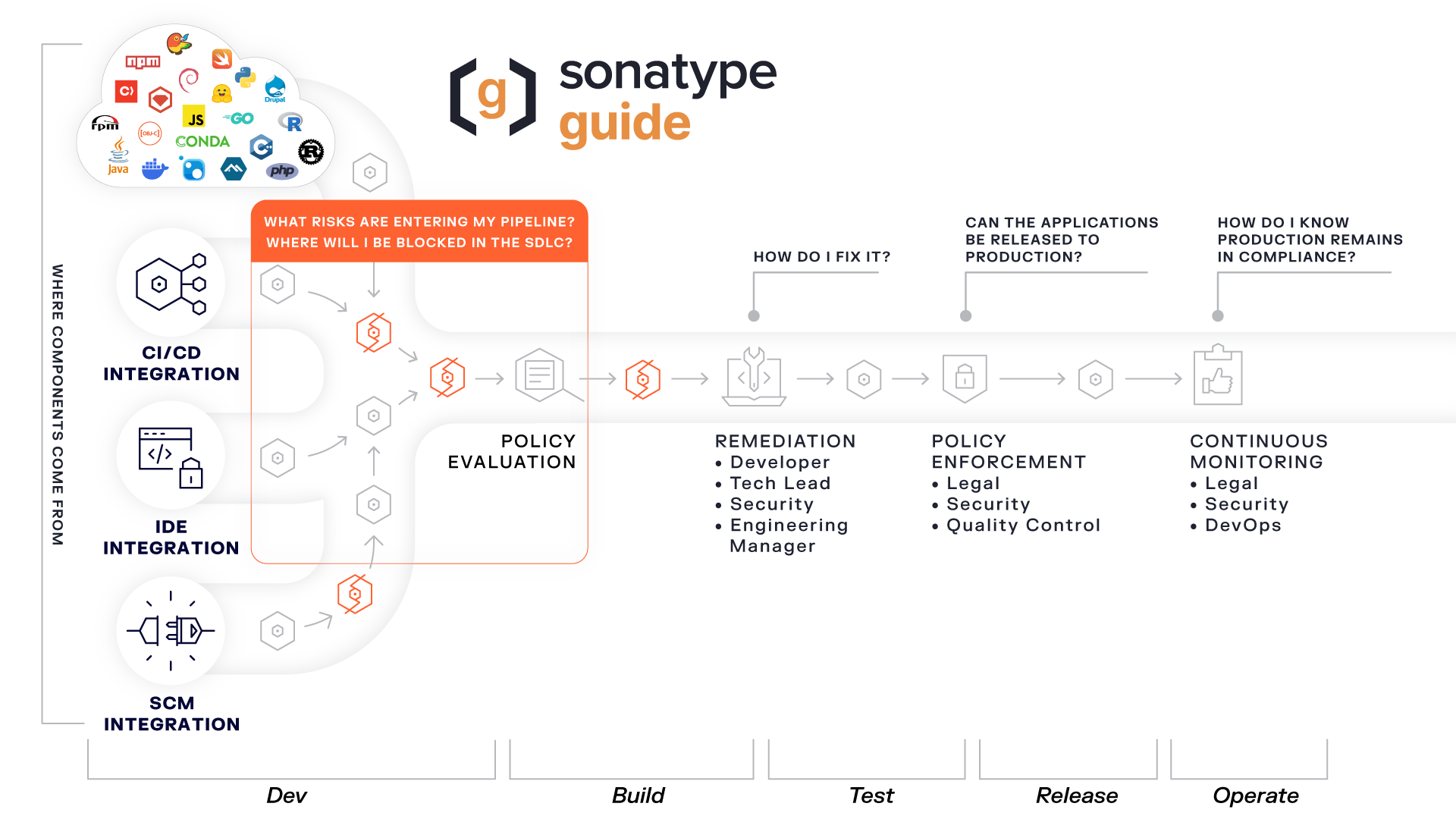
Sonatype Lifecycle empowers teams to identify and fix vulnerabilities early in the development process with automated, policy-driven governance. Its intuitive developer dashboard surfaces security, license, and quality risks directly within CI/CD workflows, enabling rapid, informed decisions. With precise component intelligence and continuous monitoring, teams gain full visibility into software dependencies, enabling them to remediate issues before they reach production. This ensures secure, efficient, and compliant software delivery from the outset.
Visibility Into Every Dependency
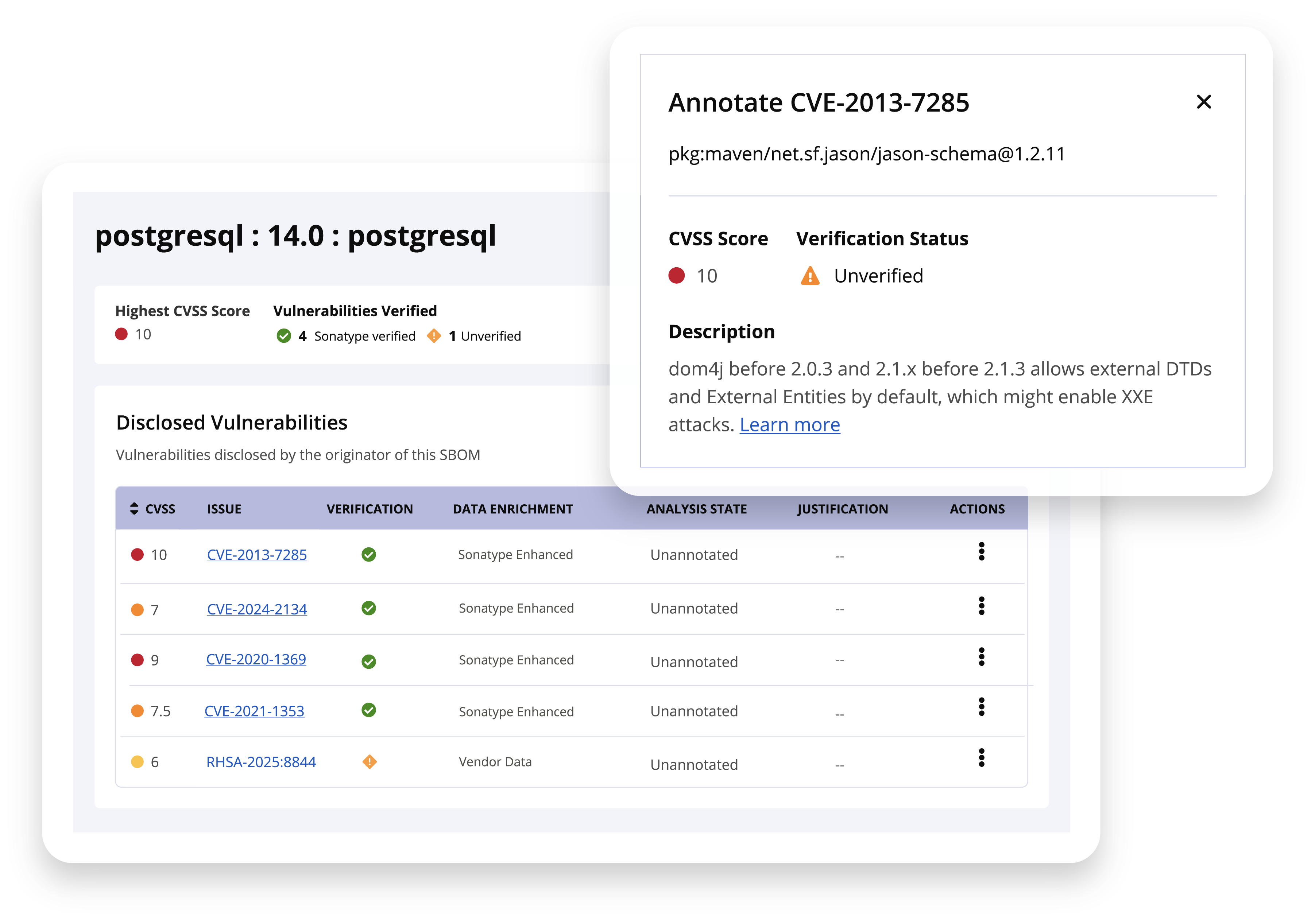
Gain complete insight into your software supply chain by identifying every proprietary and open source dependency across applications. Sonatype SBOM Manager automates SBOM creation and management, providing real-time inventory tracking, compliance assurance, and visibility into security risks. It empowers development and security teams to manage direct and transitive dependencies precisely, meet regulatory requirements, and respond quickly to emerging threats, ensuring your code remains secure, compliant, and fully understood at every stage.
A Single Source of Truth
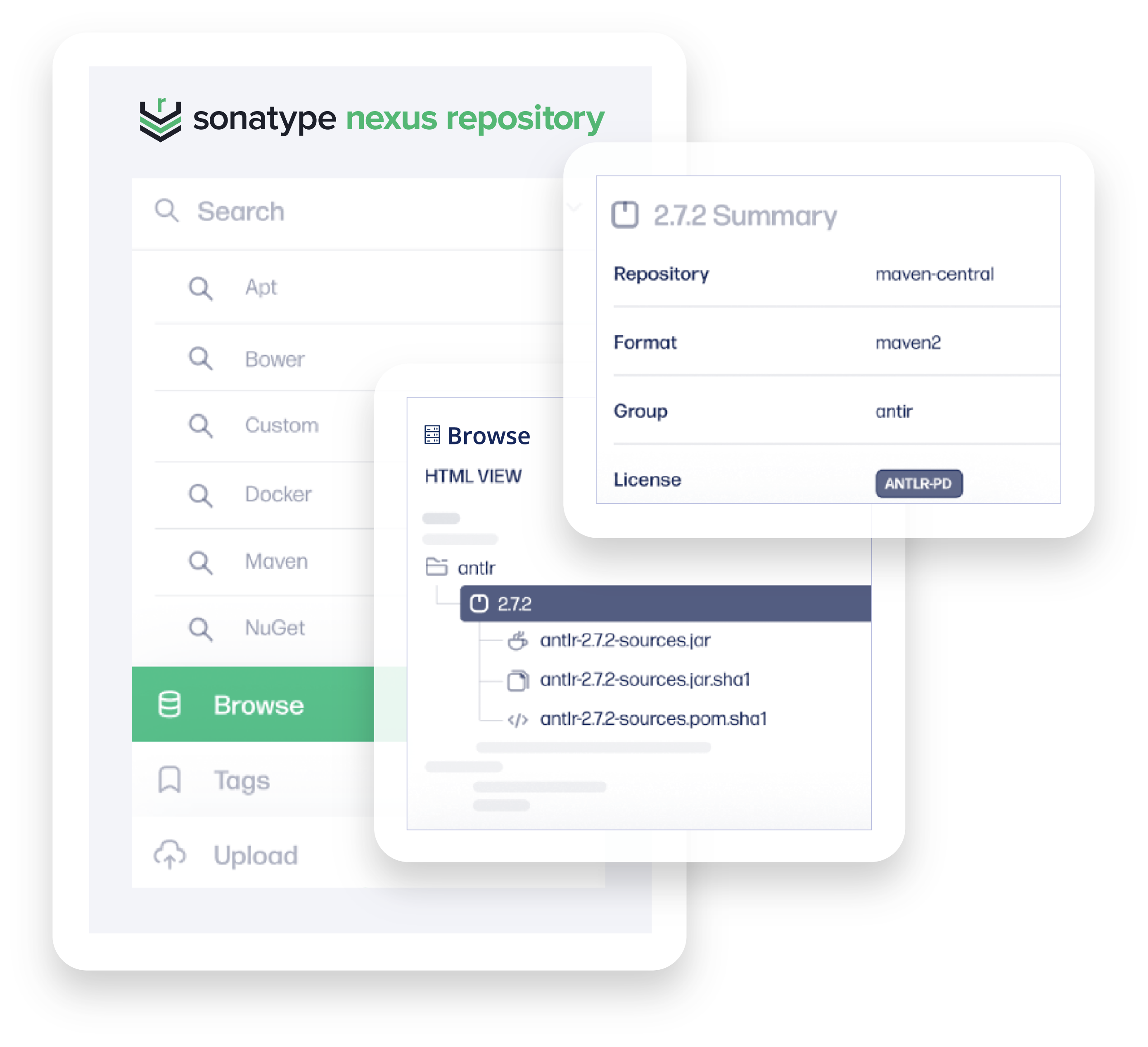
Sonatype Nexus Repository provides a centralized, universal platform for managing all your software components and binaries. It gives developers streamlined access to trusted artifacts, enabling faster builds and simplified dependency updates. Supporting multiple formats like Maven, npm, and Docker, Sonatype Nexus Repository ensures consistent, secure delivery across teams and environments. By consolidating repositories, it reduces complexity, enhances collaboration, and helps maintain control over the components flowing through your software supply chain.
Get Complete Visibility into Every Dependency with Sonatype
Dependency Management That Doesn’t Slow You Down
Faster Dev Cycles
Automate dependency updates and minimize disruptions to your development workflow.
Strong Security Posture
Identify and remediate vulnerabilities before they reach production environments.
Improved Compliance
Enforce open source license policies and avoid legal or regulatory violations.
Increased Visibility
Gain real-time insights into every component used across your applications.
Reduced Tech Debt
Proactively manage outdated libraries and prevent the accumulation of risky code.
Team Efficiency
Eliminate manual tracking so developers can focus on building software.
Why Enterprises Trust Sonatype
“Using Sonatype Lifecycle, we’re able to identify risks earlier than ever before in the development process — especially compared to six months ago. Sonatype Lifecycle works very well within our DevOps practice.”
Prem Ranganath
VP of Quality and Risk Management

“We evaluated Black Duck, Veracode and Sonatype Lifecycle. My colleagues and I chose Lifecycle because it is the best user interface for what we are trying to do: remove all critical findings before they reach production.”
LARS BRÖSSLER
Senior Software Developer
“Automated monitoring is the primary reason we chose Sonatype Lifecycle. It alleviates the time-consuming manual processes that inhibit scaling. We want to be able to have our eyes on the code and have Sonatype Lifecycle tell us when there’s something requiring our attention.”
David Blevins
CEO

Explore Dependency Management Insights and Resources
Frequently Asked Questions
What is dependency management?
Dependency management is the practice of overseeing and coordinating the external libraries, frameworks, and modules that a project relies on to function correctly. As software supply chains grow increasingly complex, dependency management becomes essential for building stable applications, reducing technical debt, and ensuring compliance. Effective dependency management tools help developers track, resolve, and maintain dependent components to ensure that applications run smoothly and securely across environments.
What are software dependencies?
Software dependencies are external libraries or components your application relies on to function. These can be open source or proprietary and are essential for building features efficiently. Sonatype helps manage these dependencies through tools like Sonatype Nexus Repository and Sonatype Lifecycle, ensuring secure and traceable usage across your development pipeline.
What risks are present in software dependencies?
Even the most well-intentioned developers can overlook the hidden dangers in third-party code. Without proper dependency management, these risks can silently compromise your software’s integrity, security, and compliance, leading to costly consequences. Some common challenges include:
- Security vulnerabilities: Outdated or unvetted open source components can expose your applications to known exploits and zero-day vulnerabilities.
- Version Conflicts: Incompatible library versions often lead to build failures, runtime errors, or subtle bugs that are hard to diagnose.
- License Compliance Issues: Untracked dependencies may include licenses that conflict with your organization’s policies or legal obligations.
- Transitive Dependencies: Dependencies of your dependencies may introduce risks you’re not even aware of, multiplying complexity and exposure.
What is the difference between a direct and transitive dependency?
A direct dependency is one that your application explicitly includes, while a transitive dependency (or indirect dependency) is pulled in indirectly by those direct dependencies. Sonatype Lifecycle provides full visibility into both types, helping teams assess risk across their entire dependency tree.
What are best practices for managing transitive dependencies to not slow down development cycles?
Best practices for managing transitive dependencies include continuous monitoring, vulnerability scanning, and establishing governance policies. With Sonatype Lifecycle, organizations can automatically identify outdated or vulnerable transitive dependencies and apply automated pull requests that not only remove direct risk but all transitive risk as well — all without slowing down development.
Are there any automation capabilities to manage open source dependencies?
Yes, Sonatype Lifecycle offers automated pull requests — also known as golden pull requests — that upgrade components to safe versions without breaking builds and safely remove all transitive risk. This automation saves developers hours of manual work per upgrade while improving security and component hygiene.
What are the benefits of using a software dependency tree?
A software dependency tree offers clear, hierarchical visibility into how components relate within an application, both direct and transitive. This structure helps identify the root cause of vulnerabilities, resolve version conflicts efficiently, and make informed decisions about upgrades. With Sonatype tools, this visibility supports faster troubleshooting and more secure, reliable builds.
Control Your Risk