
Organizations have long known that attackers publish malicious packages to public open source registries. The more consequential question is if those packages are actually reaching enterprise development environments.
In financial services, the answer is increasingly "yes."
Sonatype's malware intelligence data shows how malicious open source activity is evolving, while telemetry from Sonatype-protected financial services organizations shows those threats increasingly intersecting with real enterprise development workflows. These figures should not be interpreted as a ranking of which industries attackers target most aggressively. Rather, the financial services sector offers particularly strong visibility into this activity because of its scale of software consumption and mature software governance practices.
That makes financial services an early warning for the rest of the enterprise world.
Malicious Packages Are Reaching Development Workflows More Often
Sonatype's malware intelligence shows that malicious open source activity has accelerated significantly in the AI era, with attackers increasingly focused on influencing software selection before code reaches production.
Financial services telemetry shows a broader trend intersecting with real enterprise software consumption. Across Sonatype-protected financial services organizations, malicious packages blocked before entering development environments have increased substantially over the past several years.
The increase became especially pronounced in 2025, when these organizations blocked 893 malicious packages. By the end of Q2 2026, they had already blocked 572, more than 64% of the previous year's total.
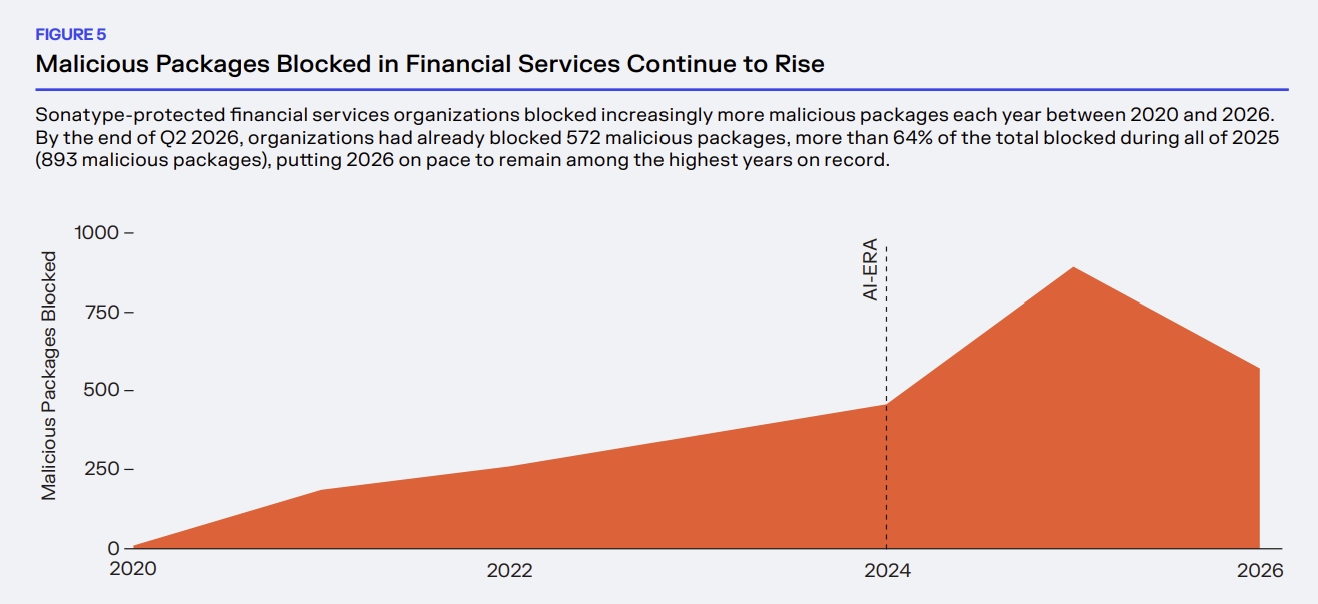
These figures represent more than malicious packages sitting in public registries. They show malicious packages reaching the point where real enterprise software decisions are made, with preventative controls intervening before those packages can enter development environments.
The trend suggests malicious open source is no longer an occasional edge case. It is increasingly intersecting with day-to-day enterprise development workflows, making preventative controls at the point of entry more important.
Why Financial Services Sees the Threat More Clearly
As a highly regulated industry, financial services organizations often operate mature software governance programs and rigorous security controls that provide greater visibility into software supply chain activity. That visibility makes the sector an important indicator of threats that may be less apparent in organizations with less mature protections.
Regulatory oversight has driven many financial institutions to invest in policy enforcement, centralized repositories, software supply chain controls, and software composition analysis. Together, these capabilities provide a clearer view of the risks associated with software consumption.
Organizations cannot identify malicious packages they do not monitor. When protections begin later in the SDLC, malicious activity at the point of software selection may be harder to see.
That's why financial services can serve as the canary in the code mine. Its mature governance and security controls make software supply chain activity more visible, offering a clearer view into how modern attacks are evolving.
Organizations with less mature controls may report fewer malicious package blocks while still carrying significant risk. Lower detection numbers can reflect limited visibility rather than safer development practices.
AI Is Accelerating Software Trust Decisions
AI is accelerating how developers discover, evaluate, and adopt software. That shift is increasing both the speed and volume of software trust decisions.
Modern applications are increasingly assembled from open source packages, third-party components, containers, AI-generated code, and software recommendations rather than written entirely from scratch. AI coding assistants and autonomous agents are accelerating software selection by helping teams:
-
Discover new software dependencies in seconds.
-
Generate implementations that introduce unfamiliar packages.
-
Evaluate and adopt more components in less time.
These productivity gains also increase the number and speed of software trust decisions.
Attackers are adapting accordingly. Rather than relying solely on broad malware campaigns, they increasingly seek to influence which components developers or AI systems choose in the first place. A package that resembles a familiar library, plugin, or utility may appear legitimate long enough to be selected and installed.
The data does not prove AI caused the increase in blocked packages. It does, however, reflect a broader shift: as software selection becomes faster, more automated, and increasingly driven by recommendations, attackers have more opportunities to exploit trust before traditional security controls can intervene.
Downstream Scanning May Miss the Earliest Attacks
Downstream scanning remains important, but it may be too late for malicious packages designed to execute during installation. Traditional application security programs often focus on identifying risk after a component enters a build or application.
Sonatype's research found that 53% of the malicious packages analyzed in 2025 targeted developer environments at install time, moving the point of risk to the moment a developer, coding assistant, or automated process selects and downloads a dependency.
Once installed, these packages may attempt to:
-
Steal credentials, access tokens, and secrets.
-
Collect host or system information.
-
Compromise developer workstations before reaching CI/CD.
By the time a downstream security scan runs, the damage may already have occurred.
For financial institutions, where developer environments often connect to sensitive systems, internal repositories, cloud services, and proprietary code, that distinction is especially important. Security controls must govern not only what reaches production, but also what enters the development environment in the first place.
What Should Other Industries Learn From Financial Services?
Other industries should not assume that lower visibility means lower risk. The financial services data shows why organizations need greater visibility into what developers and automated tools are attempting to consume, especially as open source use and AI-assisted development accelerate software selection.
Organizations should ask whether they can answer a few basic questions:
-
Which packages are developers and automated tools attempting to download?
-
Can known malicious or suspicious components be stopped before installation?
-
Are AI-generated dependency recommendations evaluated against current software intelligence?
-
Are software policies applied consistently across teams, repositories, and development environments?
-
Can security teams distinguish between lower risk and lower visibility?
These questions shift the emphasis from downstream detection to preventative governance. The goal is not to eliminate open source use or slow every dependency decision. It is to ensure that faster development does not come at the expense of informed software consumption.
Software Security Must Begin at the Point of Entry
Software governance is most effective when it begins before components enter the development environment. Financial institutions need security controls that operate where software first enters the software supply chain.
Sonatype Firewall helps organizations govern software at that point of entry by evaluating requested components and automatically blocking or quarantining identified threats before they become trusted dependencies. Sonatype Lifecycle extends that protection by continuously identifying, prioritizing, and managing open source risk across applications.
The goal is not to make every developer a malware analyst. It is to apply trusted intelligence and organizational policy automatically as software decisions are made.
For financial institutions, this approach strengthens governance, auditability, and operational resilience while allowing developers to move quickly. As AI increases the volume of software decisions, automating those controls becomes increasingly important.
Today's Financial Services Trend Is Tomorrow's Enterprise Challenge
The trends emerging in financial services are likely to become tomorrow's enterprise challenge. Financial services offers a clearer view into how software supply chain attacks are evolving.
The rise in blocked malicious packages shows these threats are no longer confined to public registries. They are increasingly reaching enterprise development workflows, where developers and AI-assisted tools make software trust decisions.
While financial institutions may be seeing this trend first because of their mature governance programs, the forces driving it, including AI-assisted development, faster software selection, and increasing automation, are reshaping software development across every industry.
Organizations that move software governance to the point of entry will be better positioned to keep pace with this changing threat landscape.
To learn more, read The Trust Economy of Software: How AI Is Reshaping Software Supply Chain Risk for Financial Services, which explores the broader shift toward precision targeting, developer-focused attacks, and increasingly sophisticated malicious package techniques.