
Application security (AppSec) tools are essential for identifying and fixing vulnerabilities throughout the software development lifecycle. As modern applications increasingly rely on open source components, choosing the right combination of tools becomes critical.
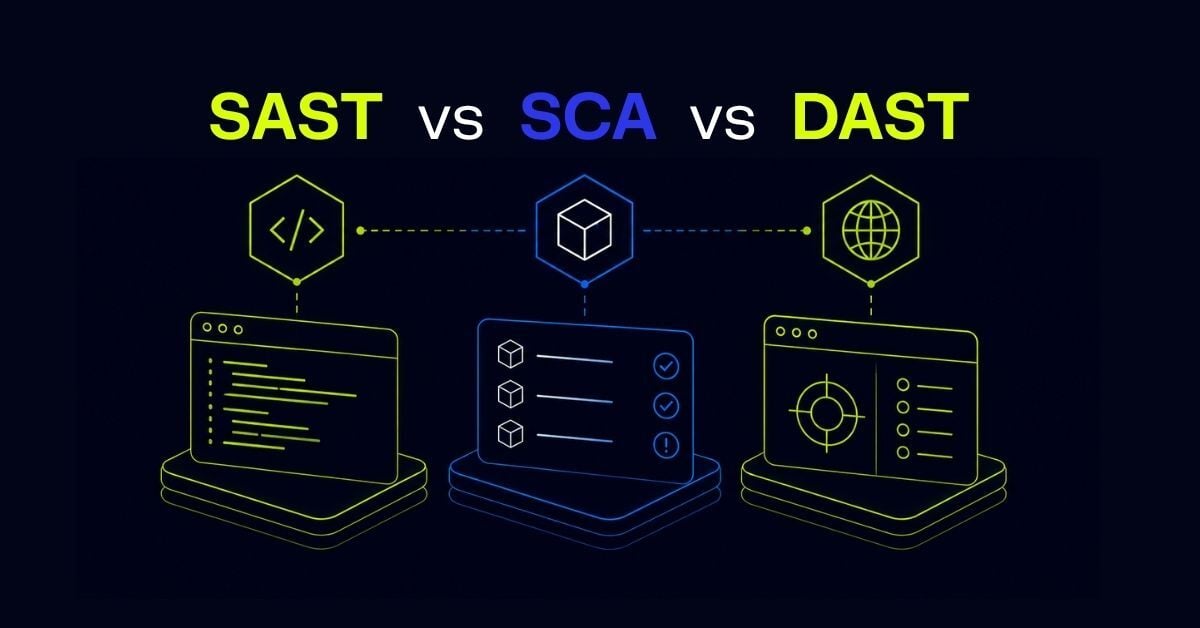
SAST vs SCA vs DAST are three core application security testing approaches used to identify vulnerabilities across the software development lifecycle. Static Application Security Testing (SAST) analyzes proprietary source code, Software Composition Analysis (SCA) identifies risks in open source dependencies, and Dynamic Application Security Testing (DAST) tests running applications for exploitable runtime vulnerabilities. Together, these AppSec tools help organizations reduce software risk, secure the software supply chain, and strengthen DevSecOps practices.
In this article we're going to address a common question asked by development and security professionals, "What's the difference between SAST and DAST and SCA?" Understanding how these tools differ and more importantly work together can help organizations build a more effective, layered security strategy.
What Are Application Security (AppSec) Tools?
Application security (AppSec) tools are designed to identify, analyze, and remediate vulnerabilities in software applications. These tools help security and development teams reduce risk, maintain compliance, and protect against increasingly sophisticated attacks.
There are several types of application security testing tools, but the most common AppSec tools include:
-
SAST (Static Application Security Testing): Analyzes proprietary source code, bytecode, or binaries to identify vulnerabilities early in the software development lifecycle (SDLC). SAST tools help developers detect coding flaws before applications are deployed.
-
SCA (Software Composition Analysis): Identifies vulnerabilities, licensing risks, malicious packages, and compliance issues in open source dependencies and third-party components. Software composition analysis tools provide visibility into software supply chain risk and help organizations manage open source governance across the SDLC.
-
DAST (Dynamic Application Security Testing): Tests running applications for runtime vulnerabilities by simulating real-world attacks against live environments. DAST testing helps uncover exploitable issues such as authentication weaknesses, misconfigurations, API vulnerabilities, and injection flaws.
-
IAST (Interactive Application Security Testing): Combines elements of both SAST and DAST by analyzing applications during runtime while leveraging instrumentation inside the application. IAST tools provide real-time vulnerability detection with greater contextual accuracy and reduced false positives.
-
API Security Testing: Evaluates APIs for vulnerabilities, authentication weaknesses, exposed endpoints, and insecure data handling. As APIs become foundational to modern applications and microservices architectures, API security testing has become an increasingly important part of modern AppSec strategies.
-
Secrets Detection: Identifies exposed credentials, API keys, tokens, certificates, and other hardcoded secrets within source code, repositories, CI/CD pipelines, and development environments. Secrets detection tools help prevent unauthorized access and reduce the risk of credential-based attacks.
-
ASPM (Application Security Posture Management): Aggregates and correlates findings from multiple AppSec tools, including SAST, SCA, DAST, secrets detection, and cloud security platforms, to provide centralized visibility into application risk. ASPM solutions help security teams prioritize remediation efforts, reduce alert fatigue, and improve risk management across complex software ecosystems.
Together, these tools provide coverage across different stages of the software development lifecycle (SDLC), helping teams shift security left while maintaining continuous protection.
Static Application Security Testing (SAST)
SAST is a security testing tool that analyzes an application's source code, bytecode, or binaries to detect vulnerabilities early in development. Often referred to as static code analysis or white-box testing, SAST tools help developers detect security flaws in proprietary code before applications are compiled, deployed, or run in production environments.
It was originally designed for environments where most applications were built primarily from internally developed proprietary code. Today, SAST remains an important component of modern AppSec programs by helping organizations identify insecure coding patterns, logic flaws, and security weaknesses during development and build phases.
SAST analyzes source code for issues such as:
-
SQL injection vulnerabilities.
-
Cross-site scripting (XSS).
-
Insecure authentication logic.
-
Buffer overflows.
-
Hardcoded secrets and credentials.
-
Input validation flaws.
-
Security misconfigurations within application logic.
|
SAST Benefits |
SAST Limitations |
|---|---|
|
Identifies vulnerabilities before code is deployed
|
Higher false positive rates if code is improperly configured
|
|
Integrates into developer workflows (IDE, CI/CD)
|
Limited visibility into runtime behavior
|
|
Reduces cost of fixing issues early
|
Does not detect vulnerabilities in third-party dependencies
|
SAST Benefits
|
Identifies vulnerabilities before code is deployed
|
|
Integrates into developer workflows (IDE, CI/CD)
|
|
Reduces cost of fixing issues early
|
SAST Limitations
|
Higher false positive rates if code is improperly configured
|
|
Limited visibility into runtime behavior
|
|
Does not detect vulnerabilities in third-party dependencies
|
Software Composition Analysis (SCA) Defined
Software composition analysis (SCA) tools help organizations identify, manage, and secure the open source components and third-party dependencies used in modern applications. Unlike SAST tools, which focus on proprietary code, SCA solutions analyze software supply chain risk by scanning open source libraries, transitive dependencies, containers, and package ecosystems for known vulnerabilities, licensing issues, malicious packages, and outdated or unsupported components.
90% of modern applications are built using open source software, with many codebases consisting primarily of third-party dependencies. As a result, vulnerabilities are often introduced through the software supply chain rather than internally developed code. High-profile incidents like Log4Shell and dependency confusion attacks have highlighted the growing importance of software composition analysis within modern AppSec strategies.
SCA tools scan applications and development environments to generate a software bill of materials (SBOM), providing visibility into every open source component used within an application. These tools surface risk using vulnerability intelligence, exploitability data, licensing metadata, reachability analysis, policy violations, architectural context, and dependency relationships.
Modern software composition analysis tools go beyond basic vulnerability detection to provide:
-
Continuous monitoring for newly disclosed vulnerabilities.
-
Detection of malicious or typosquatted packages.
-
Automated policy enforcement across the SDLC.
-
Prioritization based on exploitability and contextual risk.
-
Remediation guidance for developers and DevSecOps teams.
-
Visibility into transitive dependencies and software supply chain exposure.
|
SCA Benefits |
SCA Limitations |
|---|---|
|
Visibility into open source dependencies and supply chain risk
|
Limited visibility into custom code
|
|
Vulnerability detection and prioritization based on exploitability, reachability, or contextual risk analysis
|
Relies on public and proprietary intelligence sources (which may be incomplete)
|
|
Continuous monitoring for newly disclosed vulnerabilities
|
May generate large volumes of findings without proper prioritization
|
SCA Benefits
|
Visibility into open source dependencies and supply chain risk
|
|
Vulnerability detection and prioritization based on exploitability, reachability, or contextual risk analysis
|
|
Continuous monitoring for newly disclosed vulnerabilities
|
SCA Limitations
|
Limited visibility into custom code
|
|
Relies on public and proprietary intelligence sources (which may be incomplete)
|
|
May generate large volumes of findings without proper prioritization
|
Dynamic Application Security Testing (DAST)
Dynamic Application Security Testing (DAST) evaluates applications while they are running, simulating real-world attacks from an external perspective. Unlike SAST tools that analyze source code or SCA tools that inspect open source dependencies, DAST testing takes a black-box approach by testing applications from the outside similar to how an attacker would attempt to exploit a system.
These AppSec tools are designed to identify runtime vulnerabilities that may not be visible through static analysis alone. These vulnerabilities often emerge from how an application behaves in production environments, how services interact, or how configurations are implemented during deployment.
DAST helps organizations detect:
-
Authentication and authorization weaknesses.
-
Security misconfigurations.
-
Injection vulnerabilities such as SQL injection and cross-site scripting (XSS).
-
API and endpoint security flaws.
-
Session management issues.
-
Server and runtime environment vulnerabilities.
-
Insecure HTTP headers and exposed services.
|
DAST Benefits |
DAST Limitations |
|---|---|
|
Tests real-world exploitability against running applications
|
Finds issues later in the SDLC compared to SAST
|
|
No access to source code required
|
Slower feedback loops for developers
|
|
Identifies runtime and environment-specific vulnerabilities
|
Limited insight into root cause within source code
|
DAST Benefits
|
Tests real-world exploitability against running applications
|
|
No access to source code required
|
|
Identifies runtime and environment-specific vulnerabilities
|
DAST Limitations
|
Finds issues later in the SDLC compared to SAST
|
|
Slower feedback loops for developers
|
|
Limited insight into root cause within source code
|
SAST vs. SCA vs. DAST: What's the Difference?
When comparing SAST, DAST, and SCA, it comes down to what they are analyzing. Each AppSec tool analyzes something different. SAST analyzes proprietary code, SCA analyzes open source, and DAST analyzes running applications.
|
Function |
SAST |
SCA |
DAST |
|---|---|---|---|
|
What it analyzes
|
Source code/compiled code
|
Open source dependencies
|
Running application
|
|
When is it used
|
Early SDLC
|
Throughout SDLC
|
Late SDLC
|
|
What it finds
|
Source code vulnerabilities
|
Vulnerable open source components and licensing risks
|
Runtime vulnerabilities
|
|
Primary Strength
|
Early detection
|
Supply chain visibility
|
Real-world testing
|
|
Primary Limitation
|
False positives and no dependency insight
|
No custom code analysis
|
Late detection and slower feedback loops
|
Function
|
What it analyzes
|
|
When is it used
|
|
What it finds
|
|
Primary Strength
|
|
Primary Limitation
|
SAST
|
Source code/compiled code
|
|
Early SDLC
|
|
Source code vulnerabilities
|
|
Early detection
|
|
False positives and no dependency insight
|
SCA
|
Open source dependencies
|
|
Throughout SDLC
|
|
Vulnerable open source components and licensing risks
|
|
Supply chain visibility
|
|
No custom code analysis
|
DAST
|
Running application
|
|
Late SDLC
|
|
Runtime vulnerabilities
|
|
Real-world testing
|
|
Late detection and slower feedback loops
|
Key Differences Between SAST, SCA, and DAST
SAST only analyzes the code developers write and does not provide visibility into open source dependencies, which make up the majority of modern applications. If only using SAST, this can prove problematic for a few reasons. SAST requires access to the source files, and in some cases organizations no longer have access to the source code or access to it. It can't be compiled because it is missing key libraries, and you can't patch an issue if it is not represented in the code. With modern applications being made up of primarily open source code, this leaves the majority of an application unscanned for vulnerabilities.
SCA tools address this gap by analyzing open source components, third-party libraries, and their transitive dependencies. Unlike SAST, SCA solutions provide continuous monitoring across the SDLC and enable developers to select a better open source version that complies with policy and is also designed to work in a DevSecOps environment. SCA scans are quick and can be embedded within CI/CD to fail builds, or even further left in the developer's IDE or SCM via pull requests to fix open source components that a developer introduced.
DAST tools take a different approach by testing applications while they are running. Instead of analyzing code or dependencies directly, DAST simulates external attacks against live applications to identify runtime vulnerabilities, misconfigurations, and exploitable weaknesses that may not be visible through static analysis alone.
Rather than replacing one another, SAST, SCA, and DAST are most effective when used together as part of a layered application security strategy.
Exploring Different Approaches to Securing Modern Applications
A helpful way to understand SAST, SCA, and DAST is to compare them to building and inspecting a house.
-
SCA is like verifying the safety and quality of the building materials before and during construction. It checks whether the third-party components, suppliers, and materials being used are trustworthy, compliant, and free from known defects.
-
SAST is like inspecting the house while it's being built. It analyzes how the structure is constructed and identifies weaknesses introduced during the building process.
-
DAST is like testing the completed house from the outside to see whether doors, windows, locks, or alarms can actually be bypassed in real-world conditions.
When to Use SAST vs. SCA vs. DAST
Modern applications are built using thousands of open source components and interconnected dependencies, many of which originate outside an organization's control. Vulnerabilities can exist in the custom code developers write, in the third-party components they use, or in how the application behaves once deployed.
That's why modern DevSecOps teams rely on a layered AppSec strategy. SCA, SAST, and DAST each provide visibility into different parts of the application stack, helping organizations identify risk earlier and strengthen security across the entire software development lifecycle.
Each tool plays a role at different stages of the SDLC. Knowing when to use the right tool depends on:
-
What you are trying to secure.
-
Where risk exists within the application stack.
-
Which stage of the SDLC you are operating in.
-
How mature your DevSecOps practices are.
|
SDLC Stage |
Recommended AppSec Tool |
Primary Purpose |
|---|---|---|
|
Coding & Development
|
SAST
|
Detect vulnerabilities in proprietary source code
|
|
Build & Dependency Management
|
SCA
|
Identify open source and software supply chain risk
|
|
CI/CD Pipelines
|
SAST + SCA
|
Automate security testing before development
|
|
QA & Staging
|
DAST
|
Test running applications for runtime vulnerabilities
|
|
Production
|
SCA + DAST
|
Continuously monitor applications and dependencies for emerging risk
|
SDLC Stage
|
Coding & Development
|
|
Build & Dependency Management
|
|
CI/CD Pipelines
|
|
QA & Staging
|
|
Production
|
Recommended AppSec Tool
|
SAST
|
|
SCA
|
|
SAST + SCA
|
|
DAST
|
|
SCA + DAST
|
Primary Purpose
|
Detect vulnerabilities in proprietary source code
|
|
Identify open source and software supply chain risk
|
|
Automate security testing before development
|
|
Test running applications for runtime vulnerabilities
|
|
Continuously monitor applications and dependencies for emerging risk
|
Organizations that rely on only one AppSec tool leave gaps in their security posture. Modern DevSecOps teams use SAST, SCA, and DAST together to create comprehensive software supply chain security.
Do You Need SAST, SCA, and DAST?
The question isn't SAST vs SCA vs DAST — it's how to use them together. The reality is that no single AppSec tool can provide complete coverage for modern applications. Each tool addresses a different type of risk and each has its own limitations:
-
SAST identifies vulnerabilities in proprietary source code.
-
SCA secures open source dependencies and software supply chains.
-
DAST validates runtime security and real-world exploitability.
Relying on only one approach creates blind spots. SAST cannot identify vulnerable third-party packages. SCA does not analyze custom application logic. DAST detects exploitable weaknesses late in the lifecycle after applications are already running.
That challenge has become even more significant as modern applications increasingly rely on open source ecosystems, cloud-native architectures, APIs, containers, and complex dependency chains. Today, application risk extends far beyond internally developed code, which is why a layered AppSec strategy is essential.
How to Choose the Right AppSec Tools
Choosing the right application security tools depends on your organization's development practices, software architecture, and risk exposure. The most effective AppSec strategies align security testing with how modern software is actually built and deployed.
When evaluating SAST, SCA, and DAST tools, organizations should consider:
-
Application architecture: Monolithic applications, microservices, APIs, and cloud-native environments introduce different security requirements.
-
Open source usage: Organizations heavily reliant on third-party dependencies or innersource should prioritize strong software composition analysis (SCA) capabilities.
-
Development maturity: DevSecOps teams benefit from tools that integrate directly into developer workflows, CI/CD pipelines, and automated policy enforcement processes.
-
Compliance requirements: Regulatory standards increasingly require SBOM generation, software supply chain visibility, and continuous vulnerability monitoring.
-
Operational scale: Security tools must provide accurate prioritization and automation to reduce alert fatigue and support large-scale development environments.
A Practical Maturity Model
What we've found working with customers is that they typically start with SCA, as most of their work is with open source. They have already created some form of open source policy through either manual approvals or a whitelist/blacklist approach before starting their DevSecOps journey.
SCA becomes ideal for those focusing on holistic decisions about which third party libraries make up their applications, not individual issues like many S/D/I-AST tools. Most organizations evolve their AppSec programs over time:
|
AppSec Maturity Stage |
Recommended Focus |
|---|---|
|
Beginner
|
Start with SCA to gain visibility into open source dependencies and software supply chain risk
|
|
Intermediate
|
Add SAST to strengthen secure coding practices and shift security earlier into development
|
|
Advanced
|
Combine SAST, SCA, and DAST for layered visibility across code, dependencies, and runtime environments
|
AppSec Maturity Stage
|
Beginner
|
|
Intermediate
|
|
Advanced
|
Recommended Focus
|
Start with SCA to gain visibility into open source dependencies and software supply chain risk
|
|
Add SAST to strengthen secure coding practices and shift security earlier into development
|
|
Combine SAST, SCA, and DAST for layered visibility across code, dependencies, and runtime environments
|
SCA speeds time to innovation by automating manual open source governance processes that are prone to errors (i.e., policy enforcement) and adding context and awareness around application security. Organizations adopting DevSecOps should prioritize tools that integrate seamlessly into CI/CD pipelines and developer workflows.
The bottom line: There is no one-size-fits-all answer, but a best practice is to choose a best-of-breed SCA or SAST solution. One that provides end-to-end coverage, whether you're working in proprietary or open source code. At Sonatype, we focus on automating open source governance at every stage of the SDLC with precision to eliminate false positives and false negatives and have partnered with a leading SAST provider to analyze proprietary code.
Why SCA Is Essential to Modern AppSec
As software supply chain attacks increase, SCA has become a cornerstone of modern application security.
Today’s applications are built primarily from open source dependencies, third-party libraries, and transitive packages. As organizations consume more software from external ecosystems, dependency management has become a critical AppSec challenge.
Modern software composition analysis (SCA) tools help organizations automate dependency management by providing:
-
Continuous visibility into open source dependencies.
-
Vulnerability and malicious package detection.
-
Automated policy enforcement.
-
SBOM generation and compliance reporting.
-
Version intelligence and remediation guidance.
-
Continuous monitoring for newly disclosed vulnerabilities.
By integrating directly into developer workflows and CI/CD pipelines, SCA enables organizations to manage open source risk without slowing software delivery.
Secure Open Source With Sonatype Lifecycle
As software supply chains become more complex, organizations need continuous visibility into the open source dependencies and innersource powering their applications along with the ability to automate governance, enforce policy, and reduce risk without slowing development.
Sonatype Lifecycle helps organizations secure the software supply chain by providing end-to-end software composition analysis (SCA) across the SDLC. From the developer IDE to CI/CD pipelines and production environments, Lifecycle enables teams to identify vulnerable and malicious dependencies early, prioritize risk intelligently, and automate open source governance at scale.
With Sonatype Lifecycle, organizations can:
-
Continuously monitor open source dependencies and transitive risk.
-
Detect vulnerable and malicious packages before they reach production.
-
Automate policy enforcement across developer workflows and CI/CD pipelines.
-
Generate SBOMs and support compliance initiatives.
-
Prioritize remediation using exploitability and contextual risk insights.
-
Reduce alert fatigue with highly accurate vulnerability intelligence.
Sonatype's leadership in this space was recognized in The Forrester Wave™: Software Composition Analysis Software, Q4 2024, where Sonatype was named a Leader based on its vision, innovation, and comprehensive SCA capabilities.
Download the latest Forrester Wave report to learn why organizations choose Sonatype Lifecycle to strengthen software supply chain security and modernize dependency management across the SDLC.

Crystal is a Product Marketing Manager for the Advanced Legal Pack, Container, Cloud, and Disconnected solutions. She is passionate about amplifying the voice of the customer and product positioning. When she's not working on bringing value to the DevSecOps community, she is boxing, cooking, or playing with her dog Mila.
Tags

Discover a Better Way to SCA
Forrester evaluated 10 SCA providers and recognized Sonatype with the highest possible scores. Learn why Sonatype was named a leader in Forrester Wave™ for SCA.